

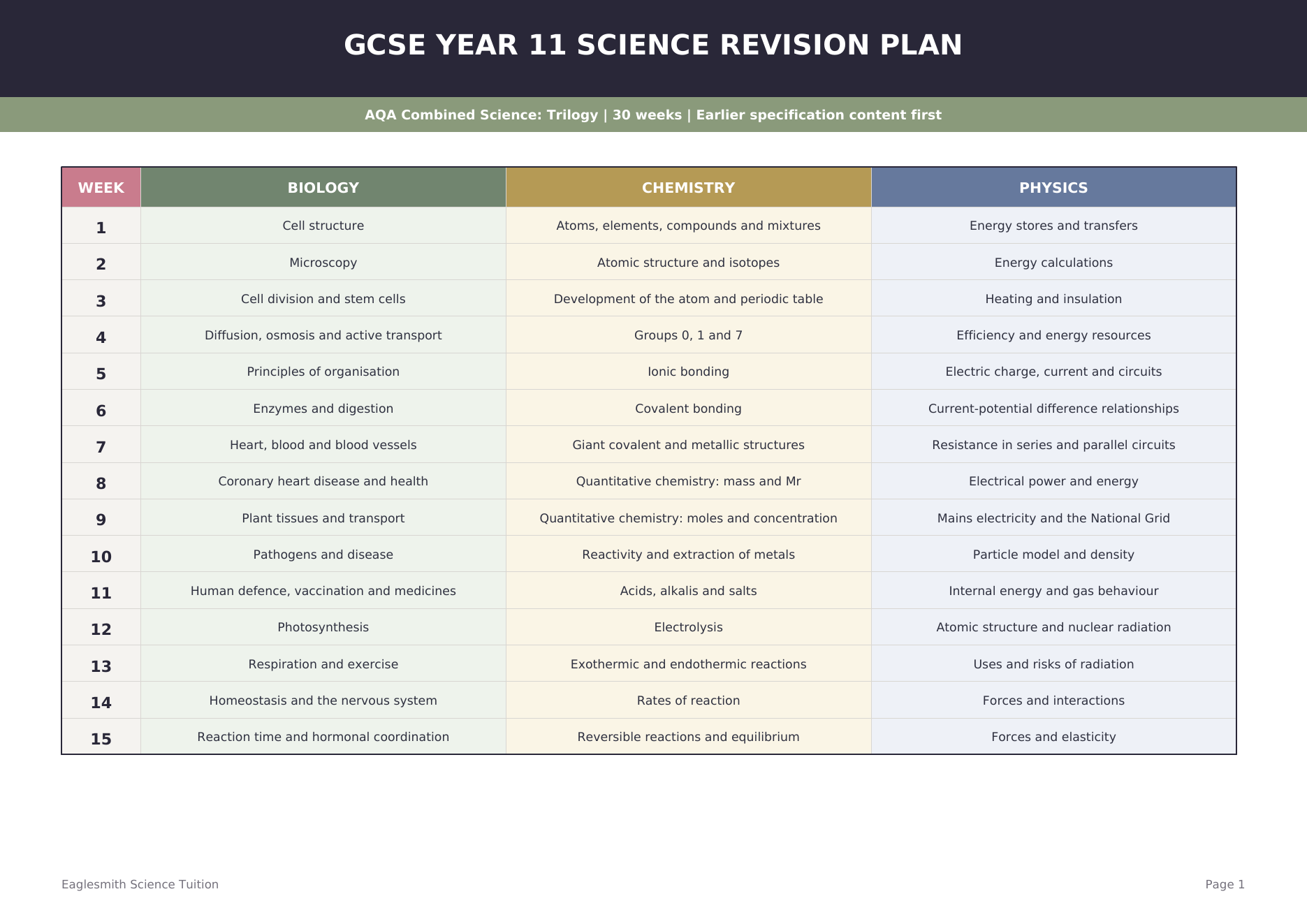
FREE YEAR 11 SCIENCE REVISION PLAN
Year 11 moves incredibly quickly. This simple 30-week plan gives pupils three manageable AQA Combined Science topics to revise each week.
The plan follows specification order and includes required practicals, calculations, six-mark questions and past-paper practice.
GCSE SCIENCE CURRICULUM
Our curriculum follows the AQA Combined Science specification and is carefully sequenced to build secure knowledge across Biology, Chemistry and Physics.
Each unit is taught as a complete block before moving to the next science. Lessons also include regular retrieval practice, exam-style questions and support with the required practicals.
The exact pace may vary slightly between groups so that we can revisit topics or address misconceptions when needed.
YEAR 9 AND YEAR 10: PAPER 1
AUTUMN 1
CELL BIOLOGY
Cells, microscopy, cell division and transport across membranes.
ATOMIC STRUCTURE
Models of the atom, isotopes and the periodic table.
ENERGY
Energy stores, transfers, calculations and energy resources.
AUTUMN 2
ORGANISATION
Digestion, enzymes, circulation, gas exchange, health and plant tissues.
BONDING
Ionic, covalent and metallic bonding, substance properties and carbon structures.
SPRING 1
ELECTRICITY
Current, potential difference, resistance, circuits, power and energy.
INFECTION AND RESPONSE
Pathogens, disease, immunity, vaccination and medicines.
QUANTITATIVE CHEMISTRY
Equations, conservation of mass, moles and reacting masses.
SPRING 2
PARTICLE MODEL OF MATTER
Density, changes of state, internal energy, heating and gas pressure.
BIOENERGETICS
Photosynthesis and respiration, including practical and graph skills.
SUMMER 1
CHEMICAL CHANGES
Metals, acids, salts and electrolysis.
ATOMIC STRUCTURE
Atomic models, isotopes and nuclear radiation.
ENERGY CHANGES
Endothermic and exothermic reactions and reaction profiles.
SUMMER 2
PAPER 1 REQUIRED PRACTICALS
Review of the key Biology, Chemistry and Physics practicals.
EXAM-QUESTION PRACTICE
A mixed Paper 1 assessment with live marking and feedback.
TARGETED REVIEW
Reteaching, calculations and exam technique based on the needs of the group.
ACCESS THE YEAR 9 AND 10 COURSE BOOKLETS
https://drive.google.com/drive/folders/1BTj46tpRXT7v_JeORlO508aj8uUlLpoc?usp=share_link
YEAR 11: PAPER 2 AND EXAM PREPARATION
During Year 11, pupils complete the Paper 2 content before moving into structured whole-course exam preparation.
Retrieval from Paper 1 is included throughout the year so that earlier learning remains active.
AUTUMN 1
HOMEOSTASIS AND RESPONSE
The nervous system, blood glucose control and reproductive hormones.
RATES AND EQUILIBRIUM
Reaction rates, collision theory, reversible reactions and equilibrium.
AUTUMN 2
FORCES
Forces and interactions, work done, elasticity, motion, Newton’s laws, stopping distances and momentum.
INHERITANCE, VARIATION AND EVOLUTION
Reproduction, genetics, variation, evolution and classification.
SPRING 1
ORGANIC CHEMISTRY
Crude oil, hydrocarbons, fractional distillation and cracking.
WAVES
Wave properties, calculations and the electromagnetic spectrum.
ECOLOGY
Competition, ecosystems, sampling, biodiversity and human impacts.
SPRING 2
CHEMICAL ANALYSIS
Purity, formulations, chromatography and gas tests.
MAGNETISM AND ELECTROMAGNETISM
Magnetic fields, electromagnets and the motor effect.
THE ATMOSPHERE
Development of the atmosphere, climate change and atmospheric pollutants.
SUMMER 1
USING RESOURCES
Sustainability, potable water, life-cycle assessments and recycling.
WHOLE-COURSE EXAM PAPERS
Dedicated practice for Biology, Chemistry and Physics Papers 1 and 2.
FINAL EXAM STRATEGY
Live marking, targeted corrections, examination planning and support with common mistakes.
SUMMER 2
GCSE EXAMINATIONS
RESPONSIVE EXAM SUPPORT
Final retrieval and question practice focused on the next examination pupils will sit.
KS4 booster classes cover the following key topics
-
BIOLOGY
Cells
Organisation
Infection and response
Bioenergetics
Homeostasis and response
Inheritance, variation and evolution
Ecology
-
CHEMISTRY
Atomic structure and the periodic table
Bonding, structure and the properties of matter
Quantitative chemistry
Chemical changes
Energy changes
Rate and extent of chemical reactions
organic chemistry
Chemical analysis
Chemistry of the atmosphere
Using resources
-
PHYSICS
Energy
Electricity
Particle model of matter
Atomic structure
Waves
Magnetism and electromagnetism
Space
KS3 booster classes cover the following key topics
-
BIOLOGY
Organisms- Movement, cells, Breathing, Digestion
Ecosystems-Interdependence, Plant reproduction, Respiration, Photosynthesis
Genes-Variation, Human reproduction,Evolution, inheritance
-
CHEMISTRY
Matter- Particle Model, Separating Mixtures, Periodic table,Elements
Reactions- Metals and non metals, Acids and alkalis, Chemical energy,Types of reaction
Earth- Earth structure, Universe, Climate, Earth’s resources
-
PHYSICS
Forces-Speed, Gravity, Contact forces, Pressure
Electricity-Voltage and resistance, Current
Electromagnets- Electromagnets and magnetism
Energy- Energy costs, Energy transfer, Worlk, Heating and cooling

The coverage of key content your child needs
I have carefully designed my curriculum of booster sessions to reflect the GCSE/IGCSE course. Booster classes are tailored to specific exam boards, so the order may vary slightly to ensure your child gets the information they need, at the most appropriate time to set them up for success.
Some parents sign their child up for Booster classes then “top up” with one to one sessions in the school holidays. This is a perfect hybrid solution for someone who wants to work with me to optimise their child’s chances of success in Science.
The earlier they join, the more chance I can have to raise their confidence and boost their grades,